Philips and Cortechs.ai extend partnership to advance quantitative neuroimaging and strengthen Philips’ leadership in precision diagnostics in neurology
Nov 19, 2025 | 4 minute read
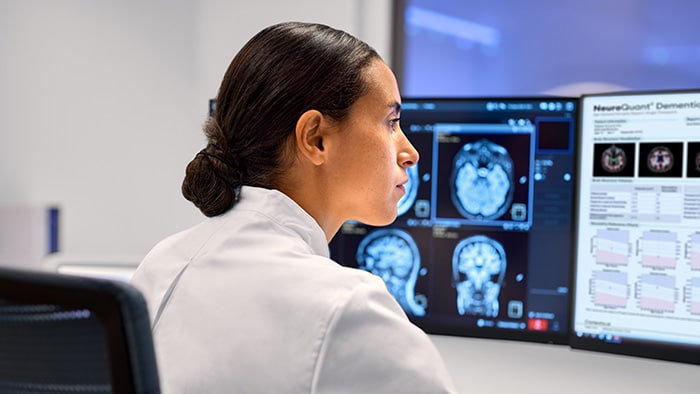
Amsterdam, the Netherlands – Royal Philips (NYSE: PHG, AEX: PHIA), a global leader in health technology, today announced an extended partnership with Cortechs.ai, a pioneer in quantitative neuroimaging solutions. Together, the companies will integrate Cortechs.ai’s advanced AI-enabled neuroimaging analytics directly into Philips’ MR systems [1], empowering clinicians with faster, more objective, and reproducible insights into brain health. The collaboration strengthens Philips’ leadership in precision neuro diagnostics, combining Philips’ next-generation MR technologies with Cortechs.ai’s AI-driven quantitative neuro imaging post processing software [1] to transform how neurological diseases are detected, monitored, and managed.

Combining complementary expertise for smarter brain imaging
Up to 25% [2] of all MR procedures are brain scans, and radiology departments face growing demand amid increasing staff shortages. At the same time, the number of patients with neurological conditions such as Alzheimer’s disease, multiple sclerosis (MS), and brain tumors continue to rise globally. Current MR interpretation of neurodegenerative diseases or neuro oncology cases depends heavily on visual assessment, introducing variability and requiring significant expertise and time in an already overloaded system.
Through this extended partnership, Philips and Cortechs.ai aim to deliver more standardized and data-driven imaging. By integrating quantitative analysis tools such as brain volumetrics, lesion quantification, and tumor tracking directly into the Philips MR imaging workflow [1], clinicians gain objective, numerical data alongside images – enabling faster, more consistent, and confident diagnoses.
Empowering clinicians with precision and speed
The integration of Cortechs.ai’s NeuroQuant® solutions for Alzheimer’s, MS and brain tumors within Philips’ Smart Reading environment – a cloud-based AI platform that combines imaging, reading, and reporting directly on the MR systems [1] – marks a major step toward precision neuroimaging.
With this integration, clinicians can automatically receive AI-generated quantitative reports within their standard MR workflow on the MR system or PACS, without adding extra steps for technologists. The zero-click process ensures quality-checked data and standardized outputs, helping radiologists interpret brain scans more objectively, faster and with greater confidence.
This integration brings precision, reproducibility, and efficiency to neurological MR, helping clinicians make faster, more confident decisions for patients living with complex brain conditions.
“By extending our partnership with Cortechs.ai, we are accelerating the transition to fully quantitative, AI-powered neuroimaging,” said Ioannis Panagiotelis, PhD, Business Leader, MRI, Philips. “This integration brings precision, reproducibility, and efficiency to neurological MR, helping clinicians make faster, more confident decisions for patients living with complex brain conditions.”
Driving productivity and improving care through AI
Philips is driving productivity and improving care through deep AI integration that tackles some of healthcare’s most pressing challenges – from workforce shortages to the growing demand for advanced diagnostics. By automatically generating quantitative reports within existing workflows, AI helps radiologists save time, improve consistency, and boost throughput. Objective numerical biomarkers enhance diagnostic accuracy, enabling more reproducible assessments and confident comparisons across time and sites. And by minimizing manual post-processing through automated, quality-controlled workflows, technologists can focus more on what matters most – delivering a better, more personalized patient experience.
“Cortechs.ai’s mission has always been to empower clinicians with actionable, quantitative insights,” said Kyle Frye, Chief Executive Officer, Cortechs.ai. “By combining our advanced neuro analytics with Philips’ leading MR platform and AI infrastructure, we’re making it easier to personalize brain care and track neurological changes with precision.”
Setting a new standard in precision neuro diagnostics
Cortechs.ai’s NeuroQuant® solutions are already available on Philips Advanced Visualization Workspace. With this extended partnership, Philips reinforces its commitment to advancing the field of neurology – empowering healthcare providers to deliver better care for more people, in less time, with greater confidence.
Sources [1] The integration of Cortechs.ai’s NeuroQuant® solutions on Philips MR systems via Smart Reading is works in progress and not available in any jurisdiction. Its future availability cannot be ensured. NeuroQuant® is currently available via Advanced Visualization Workspace.
[2] Peter A. Rinck, Magnetic Resonance in Medicine – The Basics (14th ed., revised 2025), “MRI: Facts and Figures,” available online at https://www.magnetic-resonance.org/ch/21-01.html.
The opinions and clinical experiences presented herein are specific to the featured topic(s), are not linked to any specific patient and are for information purposes only. The medical experience(s) derived from these topics may not be predictive of all patients. Individual results may vary depending on a variety of patient-specific attributes and related factors. Nothing in this presentation is intended to provide specific medical advice or to take the place of written law or regulations.
Media contacts

Contact details Contact details

You are about to visit a Philips global content page
Continue Cortechs.ai
Tel.: +1 858 459 9700
E-mail: [email protected]