AI Moves from Promise to Practice, Transforming Clinical Care Across the U.S., Philips Report Finds
New findings show AI helping clinicians expand capacity, reduce burnout and deliver better care for more people amid rising demand, workforce shortages and increasing costs
Jun 09, 2026 | 3 minute read
CAMBRIDGE, Mass. – Royal Philips (NYSE: PHG, AEX: PHIA), a global leader in health technology, today released its 2026 Future Health Index U.S. report, “AI in practice: Shaping the future of healthcare now,” revealing how AI is delivering measurable benefits across healthcare systems under growing strain. The report shows AI increasingly embedded into clinical workflows, helping clinicians regain time, improve decision-making, expand patient capacity and reduce administrative burden.

Among the key findings from the U.S. report:
The growth in adoption of AI over the last year has been nothing short of remarkable – and healthcare leaders are increasingly seeing an AI dividend.
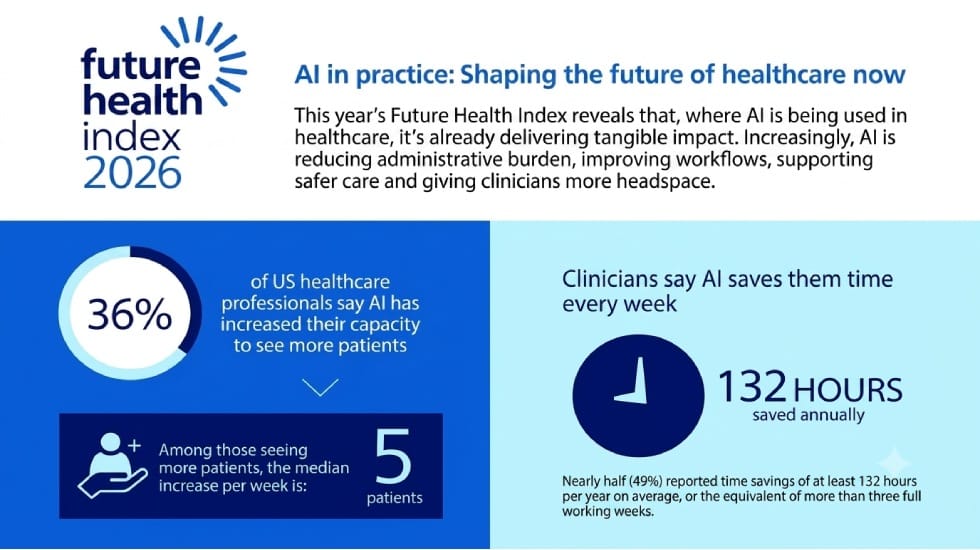
The report shows that AI adoption is becoming nearly universal among healthcare providers, with three-quarters (74%) of clinicians saying their use of AI-enabled tools provided by their organization has increased over the past year and a similar number (73%) say the use of AI-enabled tools is resulting in time-savings. Clinicians report using that regained time to focus more on patient care, clinical decision-making and higher-value tasks while also using that time to keep up to date with research and clinical developments and the ability to apply greater precision to their work.
Emerging from this year’s report is the advent of a new “hybrid care team,” where AI supports clinicians and patients while human judgment remains central to care. A majority of clinicians are comfortable with AI supporting decisions as a ‘partner’ when it comes to diagnostic decision support tools, medical image analysis tools, medical imaging processing systems and surgical guidance systems, amongst others. Importantly, more than 90% say it is essential to keep a human in the loop as AI advances.
At the same time, the findings point to ongoing readiness challenges. Nearly eight in 10 healthcare professionals say training for AI-enabled tools is limited or inconsistent at their organization, underscoring the need for stronger infrastructure, workforce readiness and governance as AI adoption accelerates.
“The growth in adoption of AI over the last year has been nothing short of remarkable – and healthcare leaders are increasingly seeing an AI dividend. Their investments are giving time back to clinicians and improving the patient experience,” said Jeff DiLullo, Chief Region Leader, Philips North America. “We’re still in the early days of this transformation. To realize these benefits across the broader healthcare ecosystem and have impact at scale, AI must be embedded seamlessly into clinical workflows and supported by consistent education and training.”


Media contacts

Contact details Contact details

You are now exiting the Philips United States (US) site and entering the Philips global site. This content is intended for a global audience. It may not apply to the US and should not be interpreted as meeting US standards, executive orders or regulations.
Continue